
Winter Roofing Guidance
Ice Dam Prevention for South Bend Roofs
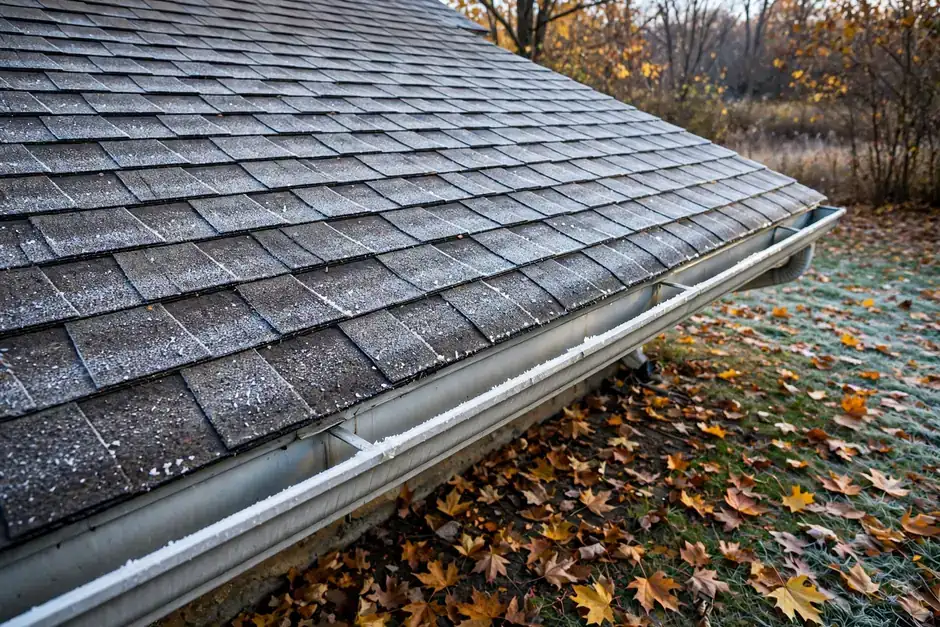
An ice dam is a ridge of ice at the eaves that traps meltwater on the roof. It starts in the attic, not at the gutter: warm air leaking upward melts snow on the upper roof, and the meltwater refreezes where the roof runs cold. Prevention works on the causes — ventilation, insulation, and air sealing — before winter arrives.
The sequence
How an ice dam forms, step by step
Every ice dam follows the same sequence. Knowing the sequence is what makes prevention possible, because each step points at a cause that can be addressed.
Attic air warms the deck
Heat from the rooms below leaks into the attic through openings between the living space and the roof. The underside of the roof deck warms above freezing, even while the air outside stays cold.
Snow melts high on the roof
Snow over the warmed deck melts. The meltwater runs down the slope toward the eaves, following the pitch of the roof.
Meltwater refreezes at the eaves
Past the exterior wall, the roof overhang sits beyond the warmed attic and stays cold. The meltwater slows, refreezes, and builds a ridge of ice along the eaves.
Water pools behind the ridge
Later meltwater has nowhere to go. It pools behind the ice ridge and can work its way under shingles and into the roof assembly, showing up as stains on ceilings and walls.
The prevention system
The three prevention measures work together
No single measure prevents ice dams on its own. Ventilation, insulation, and air sealing each address a different part of the sequence, and the three work as one system. A roof that has only one of the three still has the other two gaps open.
Ventilation: keep the deck cold
Balanced intake at the eaves and exhaust at the ridge move outside air through the attic, keeping the roof deck near the outside temperature so snow melts evenly rather than from below. Intake and exhaust work as a pair; one without the other leaves the attic half-ventilated.
Insulation: slow the heat
Insulation between the living space and the attic slows the heat reaching the roof deck. It does not stop heat entirely, which is why it works alongside ventilation and air sealing rather than replacing them. No single insulation target is stated here: published targets conflict, and the right level depends on the adopted code and the house.
Air sealing: close the leaks
Openings between the living space and the attic let warm, moist air rise directly to the deck. Sealing those openings reduces the heat source itself, which is the part of the system insulation alone cannot reach.
The three measures are also the subjects of the roof inspection and roof maintenance pages, which describe what each one looks like on a real roof.
What to look for
What a prevention check looks at
A prevention check is an attic-and-roof review before winter. It looks for the conditions behind ice dams, not for the dams themselves, which have not formed yet.
The roof inspection page describes the inspection format.
STEP 01
Attic temperature and signs of warmth
Whether the attic runs warm in cold weather, and whether frost, moisture, or uneven snow melt on the roof suggests heat is reaching the deck.
Re-roofing consideration
Ice shield at the eaves: a re-roofing consideration
The adopted code lists ice shield as required in St. Joseph County (675 IAC 14-4.4-5, the design-values table for the 2020 Indiana Residential Code). Ice shield is a membrane layer under the shingles at the eaves, and it is a re-roofing consideration: it is installed when the roof covering comes off, not added to a finished roof without disturbing the shingles. Anyone planning a re-roof in South Bend should ask how ice shield at the eaves is handled in the scope, and should verify the current code and fee schedule before relying on any summary.
The roof replacement page is the permit and code education hub for a re-roof.
A limited addition
Heat cables, honestly
Heat cables are, at most, a limited addition in a specific spot — a valley, a gutter, or a short eave run where meltwater collects. They warm one location. They do not cool the attic, seal a leak, or replace any of the three prevention measures, and the warmth behind the problem continues while they run. Any pitch that presents heat cables as the fix on their own should be read with care. Where cables are used, they sit alongside ventilation, insulation, and air sealing — never instead of them.
General guidance
If a dam has already formed
General guidance only. This section does not describe a service offered by Quality Roofing LLC.
A dam that has already formed needs care, not force. Stay off the roof: an icy roof is a fall risk, and footing cannot be trusted in winter conditions. Inside, move valuables away from any drip, catch water in containers, and photograph stains and drips with dates, so the pattern is documented. Do not try to break ice off the roof with tools, and do not pull at ice from the ground with long-handled tools; both risk damage to shingles and injury. Contact a roofing professional promptly, and ask what removal method they use, whether they are registered as a Building Contractor with the joint St. Joseph County / City of South Bend Building Department, and what the visit will cover before any work starts.
Winter signs
Signs worth attention in winter
Four winter signs, and what each one points to.
Stains after snow
Water stains on ceilings or walls that appear during or after snow, especially near exterior walls, are the sign to act on promptly.
Dams that return every winter
A dam in the same place every winter points to attic warmth, ventilation, or air sealing rather than to the eaves alone. The cause is above the ceiling, not at the gutter.
Icicles on their own
Icicles along the eaves are common in a South Bend winter and do not by themselves mean a dam has formed. Watch for water inside, not ice outside, as the signal that matters.
Uneven snow melt
Snow melting off one part of the roof while the rest stays covered can mean heat is reaching the deck unevenly. It is worth noting before the next winter, not after the next dam.
A practical standard for every visit.
Clear planningPrepared arrivalsCareful workLocal follow-through
The local climate
Why South Bend winters make this a local subject
South Bend sits downwind of Lake Michigan, in the lake-effect snow belt: cold air crossing the relatively warm lake picks up moisture and deposits it as snow downwind. The National Weather Service 1991–2020 normal for South Bend is 64.5 inches of snowfall a year — and the range around that normal is wide. Recent seasons ran from 39.0 inches (2021) to 91.8 inches (2022), and the record season reached 141.7 inches (1977–78). The code's ground snow load for St. Joseph County is 30 pounds per square foot. Snowfall varies too much from year to year for any single winter to be typical, which is why the prevention measures matter in every season, not only in heavy ones. No sourced figure exists for how often ice dams occur on South Bend roofs, and none is stated here; the case for prevention rests on the mechanism and the snowfall record, not on invented statistics.
Winter preparation notes are in the post on preparing a roof for a South Bend winter.

Where we work
Roofing in South Bend, neighborhood by neighborhood
Downtown South BendNear NorthwestRiver ParkHoward ParkSunnymedeKeller ParkEdison ParkLincoln ParkLaSalle Park
View service areas Notes from local customers
What South Bend Customers Say
The guys were able to finish the job in one day even though the short rain. They were very respectful not only to me but about my property.
Outstanding people to work with. Great price and workmanship. Clean up was exceptional, very professional company.
Warm air leaking into the attic heats the roof deck and melts snow on the upper roof. The meltwater runs down to the colder eaves, refreezes, and builds a ridge of ice that traps later meltwater behind it.
Prevention works on the causes: balanced ventilation that keeps the deck cold, insulation that slows heat reaching the deck, and air sealing that closes the leaks letting warm air rise. The three work as one system, and all three matter.
Heat cables are a limited addition in a specific spot, not a standalone fix. They warm one location while the attic warmth behind the problem continues. They sit alongside ventilation, insulation, and air sealing, never instead of them.
Stay off the roof. Protect the interior, catch drips, and photograph stains with dates. Do not try to break ice off the roof with tools. Contact a roofing professional promptly and ask what the visit will cover before any work starts.
The adopted code lists ice shield as required in St. Joseph County (675 IAC 14-4.4-5). It is a re-roofing consideration, installed under the shingles at the eaves when the covering comes off. Verify the current code before relying on any summary.
A dam in the same place every winter points to attic warmth, ventilation, or air sealing rather than to the eaves alone. The cause sits above the ceiling, and prevention works on the attic conditions, not on the ice itself.
Keep exploring
Related roofing guidance
Start with a conversation
Talk through ice dam prevention in South Bend
If ice dams have appeared on your roof, or you want to talk through ventilation, insulation, and air sealing before winter, call (574) 901-6308 and describe what you are seeing. Hours are Mon–Fri 7 AM–7 PM and Sat 8 AM–8 PM; closed on Sunday.
Start with the basics
Contact Quality Roofing LLC
Call Quality Roofing LLC at (574) 901-6308 to discuss ice dam prevention. Hours are Mon–Fri 7 AM–7 PM, Sat 8 AM–8 PM, Sun Closed. The office is at 63251 Mulberry Rd, South Bend, IN 46614. Phone is the contact channel for this business.